
Ep 7: Why Good Girls Over-Give in Relationships
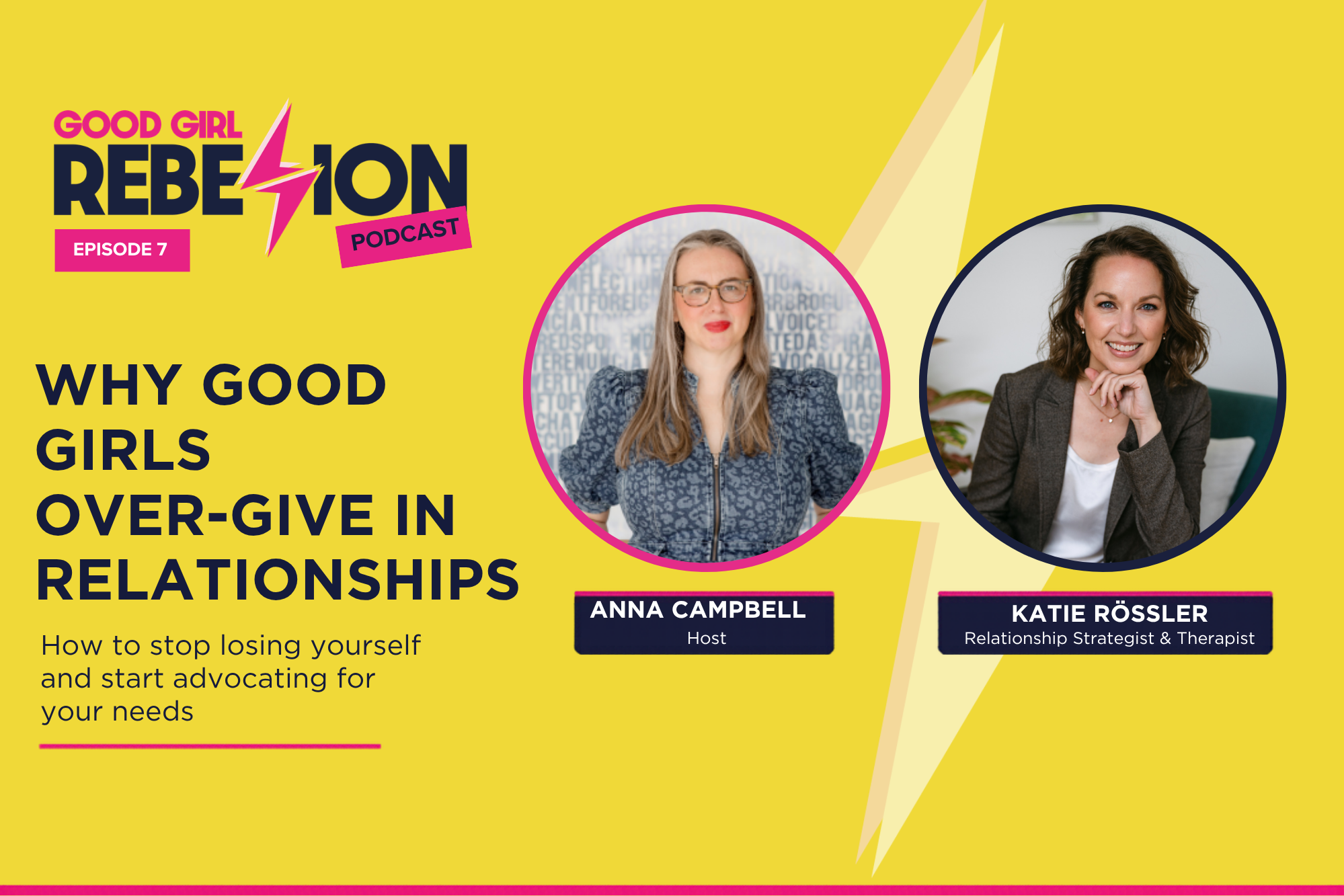
Episode 7 of the Good Girl Rebellion podcast.
Why Good Girls Over-Give in Relationships: How to Stop Losing Yourself and Start Advocating for Your Needs
This week on the Good Girl Rebellion podcast, I have my first guest interview - and what a conversation we had.
While Good Girl Rebellion as a business focuses on supporting women in business, good girl conditioning shows up in all areas of our lives - including our relationships. And that is why I invited relationship strategist and therapist Katie Rössler onto the podcast. This conversation felt like one of those big exhale moments where you suddenly realise: oh… this is why I do that.
Because our conditioning shows up in all kinds of ways including the way we over-function, the way we anticipate everyone else’s needs before they’ve even spoken them out loud and the way we quietly take responsibility for everyone else’s emotions, schedules, comfort and wellbeing and then wonder why we feel so exhausted and resentful underneath it all.
Katie works with high-achieving couples and women navigating major life transitions, and so much of what she shared connected deeply with the work I do around good girl conditioning. Because many of us have been taught, both overtly and covertly, that being loveable means being useful, easy and helpful. Being the one who handles things.
And that can become a really difficult pattern to see in ourselves and to break.
One of the things we talked about was how many women enter relationships with completely unspoken expectations. We hold ourselves to incredibly high standards. We do more than we need to, think ahead and we emotionally manage so much. We remember birthdays, organise holidays, notice what needs to be done, smooth conflict and carry the invisible labour.
And somewhere underneath all of that is often a quiet expectation that the other person in the relationship. whether with a partner, friend - whoever - will naturally reciprocate.
But they often don’t.
Not necessarily because they’re selfish or uncaring, but because they are not operating from the same internal rulebook that we good girls have. They haven’t built their identity around usefulness in the same way and this is where resentment can start to build.
I really recognised this from my own life. I can look back now at jobs, relationships and situations where I was quietly carrying far too much for far too long and then eventually I would hit a wall and think, I can’t do this anymore. But what was interesting, reflecting on this conversation, was realising how rarely I had actually said clearly: “This isn’t working for me.”
Instead, I over-delivered. I hinted. I pushed through. I carried on. And then eventually exploded internally and left.
I think a lot of good girls will recognise that pattern.
Katie talked about what happens when women become the ‘manager’ in relationships rather than the partner. The one who reminds, organises, prompts, plans and emotionally carries everything. And the difficult thing is that once you have filled that role for long enough, other people can start to assume it’s yours.
Not from any conscious decision but because your giving and their taking becomes a normal pattern. And changing those patterns can feel incredibly uncomfortable.
That was one of the biggest themes in this conversation actually: discomfort. The discomfort of asking directly, of disappointing someone. The discomfort of not immediately fixing tension or smoothing things over. Because many of us were raised to believe that other people’s discomfort was somehow our responsibility.
So we hint instead of asking.
We say things like “I’m so tired” or “I’ve got so much on” and hope somebody notices what we need, rather than directly saying, “Can you help me with this?”
And while I have definitely improved in my relationships, I recognised it from my past self.
Katie shared a story about asking her husband for more help in the mornings. He started unloading the dishwasher because in his mind, that was helping. But what she actually needed was support in getting the children ready for school. She realised she hadn’t actually asked specifically for what she needed and I think so many women do this. We expect people to infer our needs because we are constantly inferring everyone else’s.
But clear communication is a skill. And for many good girls, it’s not one we were really taught or praised for. In fact, we were praised for being the good girls who took it all on ourselves without needing to be told, so it’s no surprise that it’s our default.
Something else that really stayed with me from this conversation was Katie talking about how we often become disconnected from our own needs because we are so tuned into everybody else’s. We know what everyone around us needs emotionally. We can read the room and anticipate problems before they happen but when somebody asks us, “What do you need?” there can almost be a pause.
And I think that pause says a lot.
One of my favourite parts of the conversation was when Katie talked about the idea that other people are allowed to be disappointed. Honestly, I think that sentence alone could change a lot of women’s lives.
Because good girls are often deeply uncomfortable with disappointing people. We’d rather overextend ourselves, over-give and burn out than risk someone being unhappy with us. But protecting everybody else from disappointment often means abandoning ourselves in the process. And this doesn’t mean becoming harsh or uncaring or selfish. It’s not about becoming someone different. It’s about recognising that your needs matter too.
Katie also spoke beautifully about how many women have learned to earn love through usefulness. Through doing, helping, carrying.
And I think this is where the conversation became about so much more than relationships, because this pattern shows up everywhere. In work, friendships, business, family dynamics, motherhood and leadership. It shows up whenever we believe we have to earn rest, love, support or care through over-functioning.
One of the things Katie said was that peace becomes possible when women stop trying to earn love through usefulness and I loved that. Not perfection. Not becoming fearless overnight. Not suddenly never people pleasing again.
But peace.
A little bit more space, honesty and self-trust.
A little less resentment.
And perhaps that’s what this rebellion is really about.
Not becoming harder or caring less but finally allowing ourselves to matter too.
key moments in this episode
00:00: Introduction to Katie Rössler and why relationship dynamics matter for good girls
02:00: How good girl conditioning shows up in relationships
04:00: Over-giving, resentment and unspoken expectations
06:00: Hyper-independence and why women take on too much
08:00: Worthiness, usefulness and earning love through doing
10:00: Realising you’re quietly carrying everything
12:00: Why women struggle to ask directly for help
14:00: Becoming disconnected from your own needs
17:00: The “glass balls vs rubber balls” analogy
18:00: Why self-care is more than bubble baths and candles
20:00: Other people are allowed to be disappointed
21:00: The Glennon Doyle quote that changes everything
23:00: Childhood conditioning and managing other people’s emotions
24:00: Generational conditioning and women’s financial independence
27:00: Choosing discomfort instead of resentment
29:00: The “comfortable hell vs uncomfortable heaven” trap
31:00: Why change feels terrifying even when it’s right
33:00: Becoming the “manager” instead of the partner in relationships
36:00: Hinting instead of asking directly for what you need
39:00: Why women expect people to infer their needs
41:00: Perimenopause, boundaries and finally saying “no more”
44:00: What becomes possible when women stop earning love through usefulness
47:00: Peace, self-trust and allowing yourself to matter too
49:00: Final reflections and where to find Katie
I mentioned my free Are you Hyperindependent? Quiz which you can find here https://hyperindependentggr.scoreapp.com/
Listen to the episode
In this episode, Katie and I talk about:
why good girls often over-function in relationships
the link between usefulness and love
resentment, emotional labour and invisible work
why women hint instead of asking directly
how to stop becoming the “manager” in relationships
boundaries, disappointment and advocating for yourself
what becomes possible when women stop earning love through usefulness
Listen to Episode 7 on the links below.



watch the episode on youtube
And if this episode feels familiar, if there’s something in it that makes you go oh goodness… yes, then I hope it gives you permission to start noticing the patterns a little earlier because awareness really is the first step.
It’s time.

About Katie
Katie Rössler is a relationship strategist, licensed therapist, and creator of the REBUILD method, a transformational relationship alignment program for high-achieving, international couples. She’s the author of two books, host of the Relationship Reset podcast, and has spoken on stages around the world. With over 15 years of clinical and coaching experience, Katie guides couples from silent resentment to deep reconnection and supports women in perimenopause as they evolve into the powerful, grounded leaders they’re becoming.
Website: www.katierossler.com
Podcast: www.thebalancecodepodcast.com
Instagram: https://www.instagram.com/katie.rossler/
Behind the Transformation, Deeper Conversations on the Emotional Reality of Perimenopause https://katierossler.com/transformation/