
Ep 16: Why Being seen is so uncomfortable
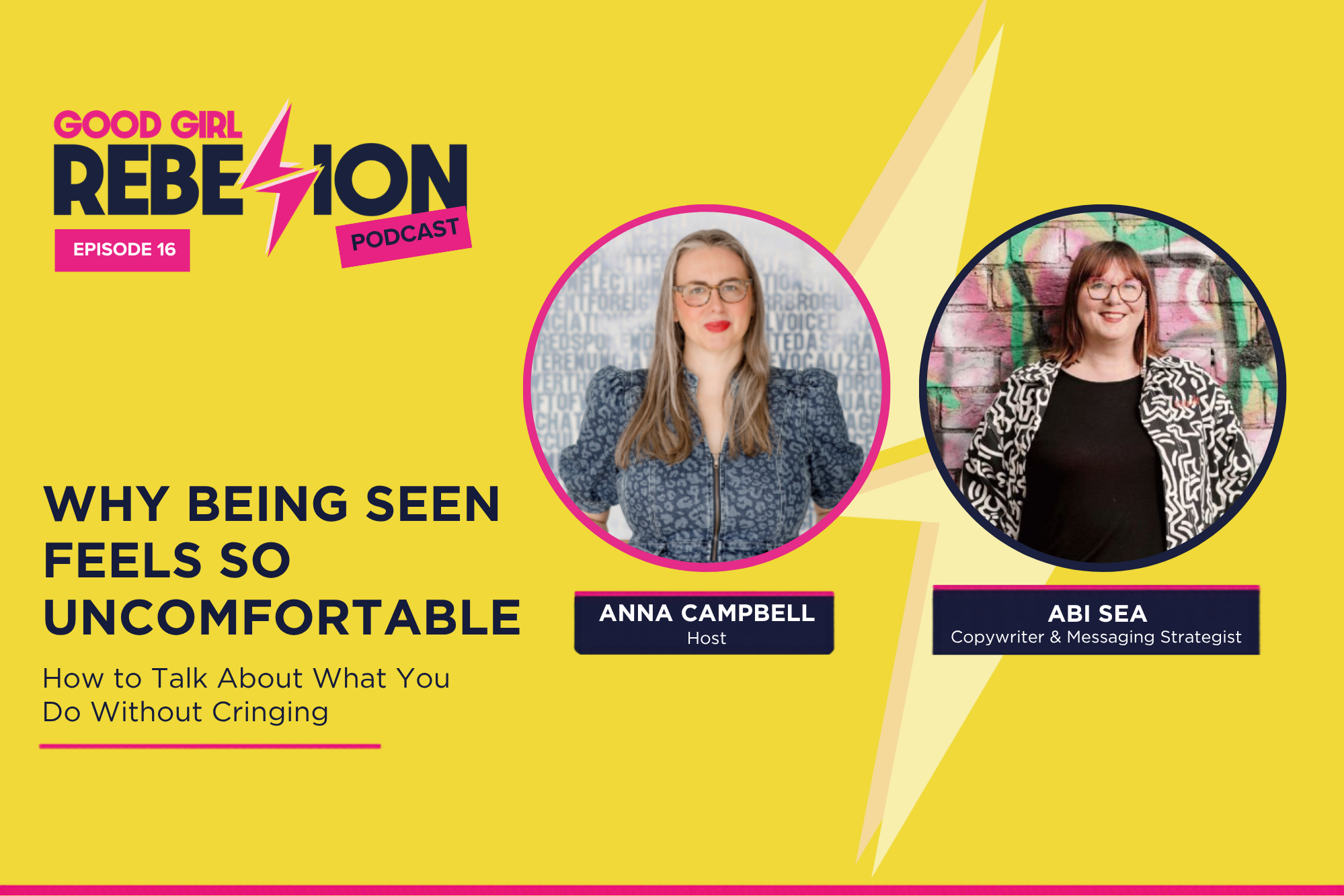
Episode 16 of the Good Girl Rebellion podcast.
Why Being Seen Is So Uncomfortable: How to Talk About What You Do Without Cringing
There is a conversation I have with women in business all the time.
They know they are good at what they do. They have experience, knowledge, happy clients and plenty of evidence that their work is valuable. This isn't necessarily a confidence problem in the way we usually talk about confidence.
The problem appears when they have to tell people about their business and their skills.
Suddenly the conversation changes and people say a version of, I don't want to sound salesy. I don't want people to think I'm boasting. I don't want to come across as full of myself.
I wanted to talk about this with my friend Abi Sea, a copywriter and messaging strategist who has spent more than 30 years working in communication, sales and marketing, because she sees this discomfort all the time. Women who are perfectly capable of talking enthusiastically about a client, recommending somebody else's work or explaining an idea they care about can find it excruciating when the subject becomes their own expertise.
And I think there is a reason for that which goes much further back than social media.
When “she loves herself” was an insult
Abi said something in our conversation that immediately transported me back to growing up in the 80s. One of the worst things you could say about another girl was, She loves herself.
It’s ridiculous when you think about it now. We have an entire self-development industry trying to help women like themselves more, yet “loving yourself” was something that could be used to put a girl firmly back in her place.
There were lots of versions of the same message. Don't show off. Don't get too big for your boots. Who do you think you are? You could be good at something, but being visibly pleased about it was different. Being aware that you were good could make you arrogant. Talking about it could make you boastful. Drawing attention to yourself could make you someone other people wanted to take down a peg or two.
Then we grew up and entered a working world that increasingly requires almost the exact opposite behaviour.
If you run a business, people need to know what you do. You need to explain why your work matters, communicate your expertise, tell people about your offers and occasionally say, without immediately qualifying it, that you are very good at something.
No wonder there is friction.
The commercial requirement is be visible. The social rule many of us absorbed was don't draw too much attention to yourself.
When visibility gets confused with arrogance
One of the Invisible Rules I have been exploring is Stay Humble. The thought underneath it might be something like, If I talk about what I'm good at, people will think I'm arrogant.
There is nothing wrong with humility. But humility and hiding are not the same thing, just as confidence and arrogance are not the same thing.
You can know that you are extremely good at your work without believing that you are better than everybody else. You can talk about an achievement without suggesting nobody else deserves one. You can explain why your experience matters without turning yourself into an online guru who appears to have cracked the entire human condition before breakfast.
But I also think some of our discomfort comes from the versions of visibility we have been shown.
Abi talks brilliantly about what she calls the “online sausages”, the people churning out low-grade ideas and advice with enormous confidence. We talked about the era of screenshots of bank balances, six-figure launches and laptops on beaches, as though the ultimate aim of entrepreneurship was apparently to get sand in your keyboard while proving to strangers how much money you had made.
If that is the version of visibility you have spent years watching, it makes complete sense that part of you thinks, I don't want to be like that.
Perhaps some women don't hate visibility at all. Perhaps we hate the version of visibility we thought we were going to have to perform.
Being liked can feel safer than being seen
Towards the end of our conversation, I asked Abi whether visibility might feel particularly uncomfortable for women because being liked has often felt safer than being seen.
I keep coming back to that distinction.
Being liked can mean staying within a fairly familiar social range. We are agreeable. We don't make too much fuss. We don't make claims that somebody might challenge. We don't express too many opinions that might divide people. We stay recognisable and acceptable.
Being seen asks for something different. Being seen means allowing people to know what we think, what we want, what we're ambitious for, what we're good at and what we stand for.
The more information somebody has about you, the more opportunity they have to decide they don't like some of it.
That is real. Women do experience judgment for being visible, and those risks aren't distributed equally. Some women face significant abuse or professional consequences because of racism, misogyny, homophobia, ableism, class prejudice or other forms of discrimination. I don't think the answer is to tell ourselves that every fear of judgment is imaginary.
But there is also a difference between recognising that judgment exists and organising our entire working lives around trying to avoid anybody ever having an opinion about us.
We don't like everybody either.
Abi made this point beautifully. Eventually, you realise there are people whose approval you don't particularly need because you don't especially like what they stand for in the first place.
We do not need universal approval. We need enough of the right people to understand who we are, what we do and why it might matter to them.
Visibility doesn't have to mean making yourself the product
One of the things that can make visibility particularly uncomfortable for people who sell services, expertise or coaching is that it can feel as though we are the product. It is much easier to enthuse about somebody else's work than to stand in front of our own and say, This is good. I made this. I can help you with this.
Abi has a useful way of shifting that focus. She calls it her Hollywood Sign or Power Message. The idea is to think about the bigger change your work contributes to, the thing you would put up in enormous letters if you could.
For me, that might be closing the self-employment pay gap or helping women recognise the Invisible Rules shaping their work and choices. For somebody else, it might be helping people create homes they love, making mental health support more accessible, changing the way an industry works or helping more creative people build sustainable businesses.
Once you know what that bigger message is, you have far more to talk about than yourself.
You can talk about what you believe, what you are noticing, what needs to change, what your clients are struggling with and what you have learned from doing the work. Your visibility becomes connected to something beyond look at me.
And that doesn't mean hiding behind the cause either. Your experience and expertise still matter. People need to understand why you are someone worth listening to. But the focus changes from How do I make myself impressive? to What do I genuinely want people to understand?
That is a much more comfortable place for many of us to communicate from.
Being excellent and being discoverable are different jobs
Abi also talked about visibility as something she now sees as part of her responsibility. She knows there are people who need the kind of help she provides, and she has also seen clients come to her after bad experiences with people who were extremely confident about marketing themselves but perhaps less careful about the work they delivered.
I liked that reframing because I think we sometimes imagine that if we are good enough, people should simply notice. But being excellent and being discoverable are different jobs.
The internet does not have a mechanism for quietly scanning every business owner, assessing their integrity and competence, and then placing the best one in front of the people who need them. If anything, we know the opposite can happen. Someone can be extraordinarily confident at communicating an offer without necessarily being extraordinarily good at delivering it.
If you believe your work genuinely helps people, making it possible for those people to find you is part of the work.
That doesn't mean you need to become louder or more performative. It means that disappearing completely has a consequence too.
Talk to one person instead of performing for everyone
Another practical idea Abi shared was to stop imagining that every piece of content is a performance in front of an enormous audience.
She has a right-fit client in mind when she writes, someone she calls Ella. Ella isn't an elaborate marketing avatar with a fictional car, coffee order and favourite Saturday afternoon activity. She simply represents the kind of person Abi loves working with.
So rather than staring at LinkedIn thinking, What am I supposed to say to the internet today?, she can ask, What does Ella need to hear from me?
I think that changes something psychologically.
A lot of the discomfort around visibility comes from imagining everybody watching us at once. Our competitors. Former colleagues. That person we went to school with. Somebody more qualified. Somebody less qualified but louder. Somebody who might disagree.
Suddenly a perfectly sensible post about your work feels as though you are giving evidence in court.
Talking to one person brings the communication back to what it actually is. You have something useful to say to somebody who may genuinely need to hear it.
The question becomes less about how you are being perceived and more about whether you are communicating clearly enough to help.
You don't have to be visible everywhere
One of the things I am increasingly convinced of is that visibility is necessary, but a particular form of visibility is not.
There is no requirement that being good at business must involve loving Instagram Reels. You do not have to enjoy making videos, post every day or turn your entire private life into content.
Abi loves LinkedIn. She enjoys being somewhere where she can talk in her own voice about the subjects that interest her, including things she doesn't necessarily feel people expect to find on LinkedIn. Instagram feels much less natural to her because she experiences more pressure around making everything look and feel a particular way.
That doesn't mean Instagram is bad or LinkedIn is good. It means different forms of visibility suit different people.
You might be brilliant on a podcast. You might love email. You might write thoughtful long-form articles. You might get most of your work through speaking, networking, collaborations or referrals.
Bold Visibility is the B in my REBEL framework because people do need to know that we and our businesses exist. But I don't want Bold Visibility to become another Invisible Rule where women feel they now have to be everywhere, all the time, in a way that somebody else's marketing strategy has prescribed.
Part of the rebellion is deciding what visibility looks like for you.
Confidence comes after the doing
Of course, understanding all of this does not necessarily mean you immediately feel comfortable pressing publish.
This is where Abi and I came back to something I talk about a lot: confidence usually follows action. It does not reliably arrive first and then give us permission to begin.
But knowing that isn't enough either. Telling somebody who feels terrified of visibility to “just put yourself out there” is not particularly useful.
Abi's suggestion is much more practical. Start with the thing you dislike least.
If writing feels comfortable, write. If email feels easier than social media, email. If LinkedIn makes sense but Instagram makes you want to throw your phone into the sea, start with LinkedIn.
Then decide what your bare minimum looks like.
Not what somebody else says consistency should mean. Not the content plan you create when you are feeling unusually energetic and optimistic. What can you actually do often enough that people continue to know you exist?
Perhaps it is one email a week. Perhaps it is two LinkedIn posts. Perhaps it is one thoughtful piece of content and several conversations.
The point is not the number. The point is creating a visibility standard you can actually meet.
Because if your marketing plan repeatedly gives you evidence that you are failing, it is unlikely to make visibility feel safer.
Practice makes comfy
Abi has a phrase for this that I absolutely love: “Practice makes comfy.”
Not perfect. Comfortable.
You may never become someone who gets an enormous thrill from talking about yourself online, and that is fine. The aim isn't necessarily to turn yourself into a different type of person.
What can change is the significance you attach to being seen.
You publish something and discover that the world continues turning. You share a win and nobody arrives to confiscate your humility. You say what you really think and the people who agree recognise themselves in it. Occasionally somebody disagrees and you discover that you can survive that too.
Over time, the behaviour becomes less unfamiliar.
This is important when we're thinking about Invisible Rules because recognising the rule doesn't mean all the discomfort disappears. You can understand perfectly well that Don't show off is an expectation you no longer choose to live by and still feel the old tug when you do something more visible.
The point isn't to wait until that feeling goes away.
The point is to recover the choice.
Somebody else's success story is not your deadline
We also talked about another kind of pressure created by the online business world: the highly compressed success story.
Abi remembers the earlier era of six-figure launches and visible bank balances. Now we often get a slightly different version. In year one the business struggled, in year two things started improving, and by year three the person had apparently cracked everything and was having £10k or £20k months.
There is nothing wrong with somebody sharing what happened in their business. The problem comes when their story stops being information and starts becoming a rule for ours.
I should be further ahead by now.
I should have figured out my offers.
I should have a bigger audience.
I should be making more money.
Real businesses are messier than that. We change direction. We discover work we didn't know existed when we started. We find out that something we thought we wanted to do all day makes us miserable. We develop expertise by doing the work. Life happens around the business too.
Somebody else's success timeline can become an Invisible Rule when it starts feeling like a deadline for your life.
Visibility gets easier when we stop treating every other person's business as evidence about how ours should look.
What change do you want to create?
I ended my conversation with Abi by asking what becomes possible when women stop asking Who does she think she is? and start asking What change do I want to create?
I think that gets to the heart of the episode.
There are plenty of reasons visibility can feel uncomfortable, and I don't think the answer is to become someone who no longer cares what anybody thinks. Most of us care about belonging, relationships and how we affect other people. Those things are not weaknesses we need to eliminate.
But we can start noticing when the desire to remain acceptable is making us less visible than we actually want to be.
We can recognise that talking about our work is not inherently arrogant. We can choose forms of visibility that suit us. We can speak to the people we actually want to reach rather than performing for an imaginary crowd. We can put more of our attention on the change we're trying to create and less on endlessly monitoring how we might be perceived.
And then we can practise.
Not until we become perfect at visibility. Not until everybody likes us.
Until being seen feels a little more normal.
Listen to Why Being Seen Feels So Uncomfortable
Listen to Episode 15 on the links below.


In this episode of the Good Girl Rebellion Podcast, I'm joined by copywriter and messaging strategist Abi Sea to talk about why so many women know they are good at what they do and still find talking about their work uncomfortable.
We explore good girl conditioning, visibility and arrogance, why “she loves herself” was once such a powerful insult, the fear of social judgement, why the versions of online marketing we have been shown matter, and how to find a way of communicating that actually feels like you. Abi also shares her Hollywood Sign exercise, her approach to bare-minimum visibility and why she believes that when it comes to showing up, practice doesn't make perfect. It makes comfy.
If you've ever known exactly what you want to say and then edited yourself into oblivion the moment you imagined other people reading it, this conversation is for you.
Listen to Why Being Seen Feels So Uncomfortable: How to Talk About What You Do Without Cringing on the Good Girl Rebellion Podcast.
It's time.

About abi
Abi Sea is a trained copywriter with over 30 years experience in comms, sales and marketing. She's been writing for clients since 2015 and after a year of being fully self employed, lost every client in less than 48 hours in the pandemic. Ever resilient, she pivoted to supporting other business owners with their online presence, and quickly fell in love with all things messaging. Now she works with solo bs (that's solo business owners in Abi's world), coaches and experts who want to attract brilliant clients without faking a personality online. She's a huge advocate for using positive psychology in marketing and helps her clients get x-ray vision on their messaging, content, offers and visibility.
She's a co-director of a successful community CIC called the Big Green Market which has raised over £60,000 for the local community, the co-host of the Fife branch of The Marketing Meetup and is the co-founder and co-host of Scotland's best marketing and business event - Adventures in Marketing.
At 51, she's surfing the waves of menopause and ADHD, and is doing a pretty good job with both...mostly! She lives in a seaside town in Fife in a very neurodiverse house. She has two teenagers, two cats and a husband who constantly brings her snacks because she loves her work so much she's always in hyperfocus and forgets to eat.