
Ep 17: Why You’re Doing Everything But Selling
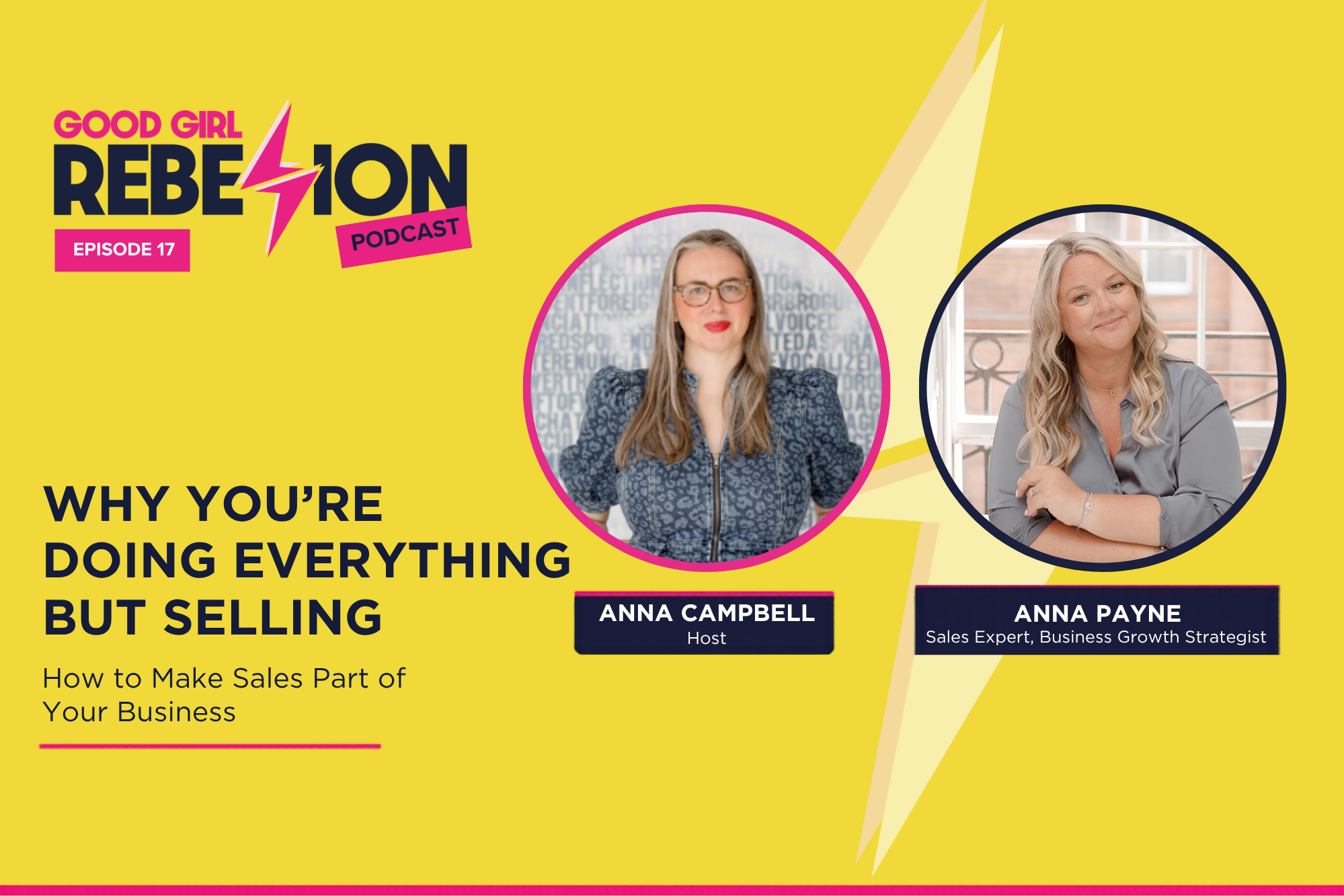
Episode 17 of the Good Girl Rebellion podcast.
Why You’re Doing Everything But Selling: How to Make Sales Part of Your Business
You can be so busy working in your business and still avoid selling. One of the reasons sales avoidance can be so difficult to spot is that it often looks exactly like work. You might be creating content, updating your website, working on your messaging, changing your prices, serving existing clients, taking another course or spending an afternoon making something beautiful in Canva. None of those things is necessarily a waste of time; some of them may be essential. But there is still a useful question to ask yourself: when did you last do something that could directly lead to somebody buying from you?
That was the starting point for my conversation with sales expert and business growth strategist Anna Payne on the Good Girl Rebellion Podcast. Anna has a phrase for this behaviour that is painfully recognisable: Anything But Sales, or ABS. It is what happens when we fill our time with perfectly legitimate business activity while repeatedly avoiding the parts of running a business that involve asking, offering, following up and allowing somebody else to make a decision.
What I find interesting about this is that it takes us beyond the usual conversation about whether someone is ‘good at sales’. We can know an enormous amount about business. We can understand marketing, pricing, social media, client delivery and our own expertise. We can be conscientious, experienced and very hardworking. And still, when we get to the moment where we have to say, this is what I offer, this is what it costs, would you like to work with me?, something changes.
When being busy becomes a way of avoiding the sale
Anna describes ABS as something that can show up in several ways. Sometimes we really are busy. We have clients to serve, projects to complete and responsibilities that need our attention. When there is plenty of work coming in, it can feel perfectly reasonable to stop thinking about sales for a while. The difficulty comes later, when those projects finish and we suddenly realise there is nobody waiting behind them.
That is how a lot of small businesses end up in a feast-and-famine cycle. When there is plenty of client work, sales stops. When the work dries up, selling becomes urgent. Then more work arrives, sales gets abandoned again, and the whole thing repeats itself.
At other times, the avoidance is subtler. We tell ourselves we need to finish the qualification first, sort out the website, improve the messaging, build the audience, revisit the pricing or get more visible. All of those things may genuinely need attention, but sometimes they also give us somewhere to hide.
I think that is an important distinction, because the answer is not to dismiss marketing, professional development or good client service as distractions. It is to get more honest about what purpose the activity is serving. Is it helping the sale, or has it become a respectable way of delaying the part that feels more vulnerable?
This also helps us separate marketing from sales. Marketing helps people find us, understand what we do and become interested in our work. Selling asks something different. It moves the relationship towards a decision. That might involve starting a conversation, asking a question, making an offer, following up or making the next step clear.
You can therefore be highly visible and still have a weak sales process. People can read your posts, enjoy your newsletters, listen to your podcast and think you are brilliant, while having very little idea what they could actually buy from you or how to go about it. Visibility matters, but it only takes someone part of the way.
One of the simplest ways I have started thinking about it is this: visibility helps people find you; selling helps them decide.
Sometimes “I don’t want to be salesy” means “I don’t want to ask”
There is another layer to this that feels particularly relevant to Good Girl Rebellion. So many women tell me they do not want to be salesy or pushy. They do not want to manipulate anyone or make somebody feel pressured into buying.
I completely understand that. I do not want to sell like that either, and neither does Anna. In fact, much of her work is built around rejecting the old-fashioned sales tactics that rely on pressure, manufactured urgency or continuing to push after someone has said no.
But during our conversation I found myself wondering whether “I don’t want to be salesy” sometimes covers something more uncomfortable: I don’t want to ask.
Because asking creates the possibility of an answer, and the answer may be no.
That is where selling can become psychologically loaded in a way that is easy to underestimate. If you have been rewarded throughout your life for being helpful, accommodating, easy to work with and not asking for too much, then making a direct offer can feel like more than a business activity. It can bump up against older ideas about what is acceptable, likeable or appropriately modest.
This is where an Invisible Rule such as Don’t Ask for Too Much can start influencing a business without ever announcing itself as a sales problem. It can sound perfectly reasonable: I don’t want to bother them. They know where I am. If they wanted it, they’d ask. I’ve mentioned it once already. I don’t want them to think I’m pushy.
Sometimes those are completely valid judgements, not every person needs another follow-up. Not every conversation needs an offer. The point is not that we should bulldoze our instincts or turn every interaction into a sales opportunity.
The more interesting question is whether we are giving the other person room to decide, or deciding for them because we do not want to risk hearing their answer.
A revelation for me was when I heard the phrase, ‘don’t say no to yourself’. If you never make the offer because you have already decided they probably do not want it, you are protecting yourself from rejection, but you are also removing their opportunity to choose.
And I actually think there is something slightly controlling in that, even though it can feel like politeness. We tell ourselves we are being considerate, but we are also assuming we already know what somebody else wants.
Selling does not require us to force the answer. It requires us to ask the question and let the other person decide.
Why selling yourself can feel different
One of the most revealing parts of the episode came when Anna talked about her own transition into solo entrepreneurship. By that point she already had extensive sales experience. She had built businesses, sold services and knew the mechanics of selling extremely well.
And yet, once the thing she was selling became more closely attached to her own knowledge and expertise, it felt different.
She found herself working for free, reducing her prices without being asked, overdelivering and avoiding calling herself an expert despite having years of experience behind her. She described people giving her obvious buying signals and her still finding ways not to charge properly.
I think that story matters because it shows why telling women to “just get better at sales” can miss the point. Anna already knew how to sell, the difficulty was not a lack of technique. What had changed was what the sale represented.
Selling behind a company or a brand creates a certain amount of distance. Selling your own thinking, experience, knowledge or creativity can feel much more exposed. Suddenly the offer is connected to questions such as Am I good enough to charge this? Am I experienced enough to call myself an expert? What if they don’t want it? What if I’ve overestimated my value?
This is where Stay Humble can become expensive. Humility itself is not the problem; I value humility enormously. But there is a difference between being humble and refusing to describe your own expertise accurately.
There is also a reason so many women find it easier to advocate for other people than for themselves. We can happily recommend someone else, talk about a colleague’s strengths or explain why a client deserves recognition. When we have to make the same case for our own work, the emotional stakes can change.
And that can have very practical commercial consequences.
When generosity becomes part of the avoidance
This is one of the areas I find most interesting because overgiving is already such a familiar pattern for many women in business.
Giving often feels good. We can share useful content, answer questions, offer advice, add something extra for a client or spend more time than we planned helping somebody. Sometimes that is simply generosity. Sometimes it is part of excellent service. Sometimes it is exactly how we want to work.
But there are moments when giving more becomes easier than asking.
If I keep providing value, perhaps I never have to say, this is the paid part. If I keep proving how helpful I am, perhaps I can avoid the moment where I put a price on that expertise. If I make the free material good enough, perhaps people will simply work out for themselves that they should buy.
That does not mean we need to become less generous. It means we need to notice the difference between generosity that is chosen and generosity that is protecting us from something.
Anna’s own experience of working for free and undercharging is a particularly useful example because she knew better. She understood sales. She understood business. The issue was not education. It was the vulnerability of making the ask on behalf of herself.
Sometimes overgiving is not simply a time-management problem or a boundary problem. It can also be a way of staying on the safer side of the transaction, where we get to help without having to risk being refused.
A “no” is information, not a verdict
Of course, one of the reasons the ask can feel so loaded is that many of us attach far too much meaning to the answer.
If somebody saying no means I’m not good enough, then every sales conversation becomes emotionally exhausting. If somebody not replying means I’ve embarrassed myself, follow-up starts to feel unbearable. If one unsuccessful offer becomes evidence that the whole business is not working, then avoiding sales starts to make perfect sense.
Anna’s approach is much more practical. Her job is not to force somebody into saying yes. It is to help them reach a decision. That decision might be yes, no or not now.
That is also how she thinks about follow-up. Follow-up is not supposed to be the part where we wear somebody down until they give in. It is simply a way of helping the conversation reach a conclusion.
I think that distinction removes a lot of the unnecessary drama. If the goal of selling is not make them say yes, but help them make a decision, then a no is not a failed conversation. It is a decision. It gives you information and it allows both sides to move on.
This also matters because sometimes the answer genuinely is not now. Someone may like your work, understand the offer and still not be ready to buy. If the relationship has been handled well, that does not have to be the end of it.
The more we can separate the outcome of one conversation from our entire sense of ourselves, the easier it becomes to keep going.
Making sales less emotionally charged
This is where I think Anna’s practical approach becomes particularly useful. She talks about “Sales First”, which for her means spending 30 minutes at the beginning of the working day on sales activity.
I like the simplicity of that because sales can easily become something we imagine requires a huge personality transplant. We think taking sales seriously means spending our entire day chasing strangers around the internet or becoming much more aggressive than we want to be.
In reality, consistent sales activity can be much smaller and more ordinary than that.
For a service business, that might mean following up an enquiry, starting a few conversations, reconnecting with someone you spoke to several months ago, making an offer or checking in with a previous client. For a product business, it might involve improving an abandoned-cart email, following up after purchase, asking for reviews or giving existing customers a reason to return.
Anna describes the customer journey in five broad stages: becoming visible to the right people, identifying and nurturing potential leads, making offers, following up and then thinking about the longer-term relationship with the client or customer.
The exact approach will depend on the business, but the principle is useful because it moves sales out of the category of thing I do when I panic about money and into the ordinary rhythm of running the business.
That matters psychologically too.
When you only make an offer occasionally, each offer can start to carry enormous weight. This one needs to work. I need this client. I really hope they say yes. The stakes become much higher than they need to be.
If sales activity is happening regularly, every individual conversation matters less. A no is disappointing, perhaps, but it is not catastrophic because it is one conversation among many.
Anna talked about doing a sales sprint in her own business and taking a lot of action without immediately seeing the financial return. Her reframe was that the win was in the action. You can control whether you start the conversation, make the offer or follow up. You cannot completely control when somebody is ready to buy.
That idea is simple, but I think it is powerful because it moves our attention back to the part we can influence.
If you are not doing any of this, that might actually be good news
There was a point in the conversation where I could imagine someone listening and thinking, Oh. I’m not doing any of that.
Perhaps you are not following up. Perhaps you rarely make a direct offer. Perhaps most of your time goes into content and delivery. Perhaps your sales process is essentially “people know where I am if they need me”.
If sales are also inconsistent, that realisation might feel uncomfortable. But I actually think it can be very good news.
Because now you have found a gap.
And, as Anna put it, gaps equal opportunity.
It is much more useful to discover that you are not consistently doing sales activity than to conclude that nobody wants what you offer or that you are simply “bad at business”. There is something concrete to experiment with.
And once you start taking more sales action, you get much better information. Perhaps people are interested, but the offer is unclear. Perhaps the pricing needs work. Perhaps you are talking to the wrong audience. Perhaps your positioning is confusing. Or perhaps people start buying.
You cannot learn very much about whether an offer works if you rarely offer it.
That is why action matters. It does not guarantee an immediate sale, but it gives you data. It gives you feedback. It tells you where the real problem is.
Selling as agency
I ended the conversation by asking Anna what becomes possible when we stop treating selling as something slightly embarrassing that we have to do and start treating it as part of helping the right people make a decision.
Her answer was, essentially, everything.
That might sound grand for a conversation about sales, but I understand what she means. Selling is what allows the business to keep existing. It allows us to pay ourselves, invest, create, employ people, develop new ideas, choose how we work and build something that supports our lives rather than constantly draining them.
For many women who have chosen self-employment because they wanted more autonomy, selling is directly connected to that autonomy. A sustainable business creates choices. It gives us more influence over how we spend our time, what work we take on, what we say yes to and what we can afford to say no to.
That does not mean money is the only measure of success. It means that if we want the business to support us, it has to generate revenue.
We do not have to become pushy to do that. We do not have to manipulate anyone or persuade people who do not want what we sell. We do not have to turn every conversation into a transaction.
But we do have to let people know what is available. We have to create a route towards working with us. We have to make the offer and allow somebody else to decide.
So if you recognise yourself in Anything But Sales, I would not turn it into another reason to criticise yourself. I would get curious instead.
What are you doing that is genuinely helping the business move forward? What are you doing because it feels safer than asking? And what small piece of sales activity could become part of your regular working week so that selling no longer only happens when you desperately need it to work?
Perhaps the most useful question is not How can I become better at sales?
It is simply: What am I avoiding asking for?
Listen to Why You’re Doing Everything But Selling: How to Make Sales Part of Your Business on the Good Girl Rebellion Podcast.
Listen to Episode 17 on the links below.


In this episode of the Good Girl Rebellion Podcast, I'm joined by copywriter and messaging strategist Abi Sea to talk about why so many women know they are good at what they do and still find talking about their work uncomfortable.
We explore good girl conditioning, visibility and arrogance, why “she loves herself” was once such a powerful insult, the fear of social judgement, why the versions of online marketing we have been shown matter, and how to find a way of communicating that actually feels like you. Abi also shares her Hollywood Sign exercise, her approach to bare-minimum visibility and why she believes that when it comes to showing up, practice doesn't make perfect. It makes comfy.
If you've ever known exactly what you want to say and then edited yourself into oblivion the moment you imagined other people reading it, this conversation is for you.
Listen to Why Being Seen Feels So Uncomfortable: How to Talk About What You Do Without Cringing on the Good Girl Rebellion Podcast.
It's time.
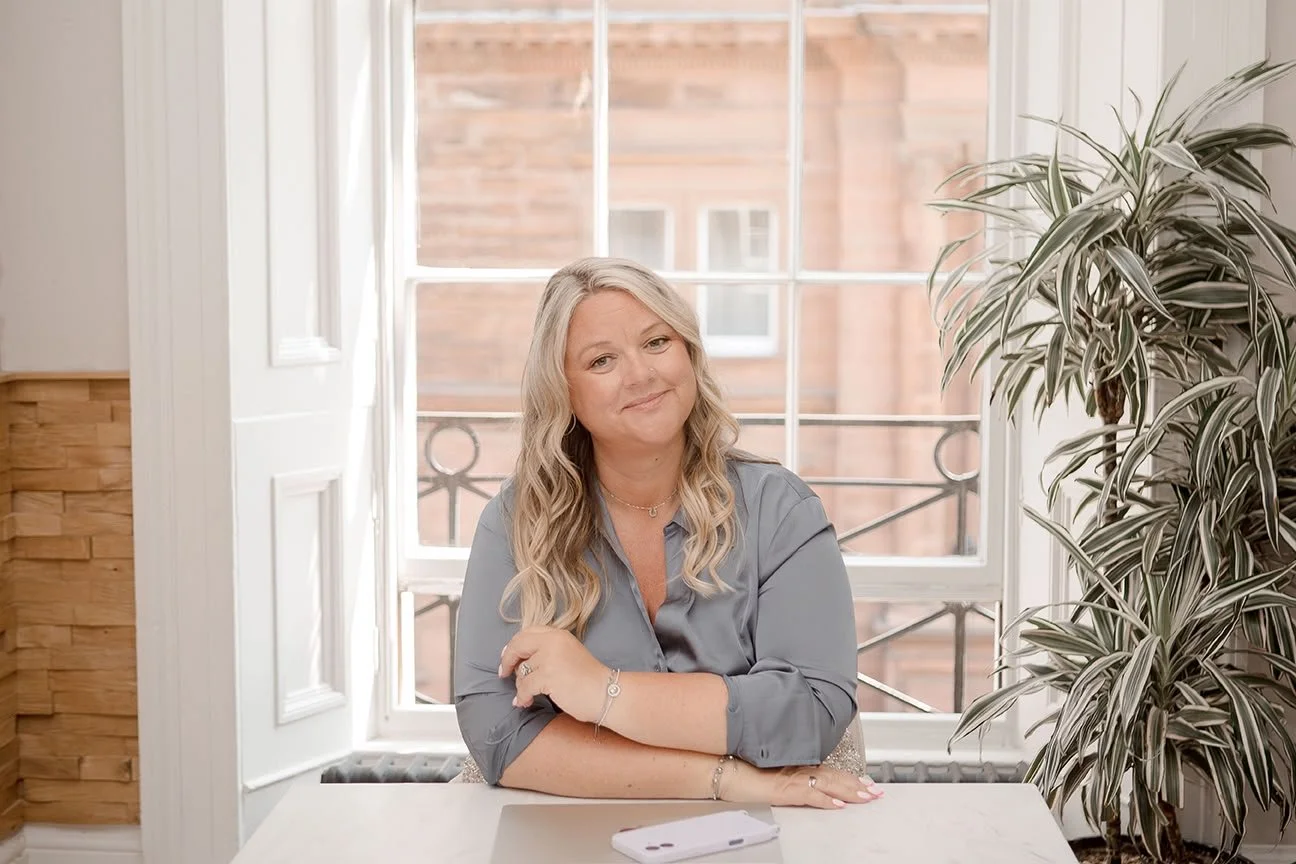
About ANNA
Anna Payne is a sales expert and business growth strategist with more than 25 years’ experience across sales, leadership and entrepreneurship. She has built and scaled three successful businesses, sold millions of pounds of services and consultancy internationally, and is the author of the bestselling book Everything You’ve Been Taught About Sales Is Wrong (Probably).
Her work helps business owners stop avoiding sales, build simple and repeatable sales strategies, and become more comfortable with selling without becoming pushy, manipulative or someone they are not. She also hosts the How to Make More Sales podcast, where she shares practical, actionable strategies to help business owners create more consistent sales.
https://www.annapayne.online/quiz
https://www.instagram.com/annapaynesales/
Check out Anna’s podcast ‘How To Make More Sales’ https://www.themakemoresalespodcast.com/