
Ep 15: Why Being Your Own Safety Net Isn’t Working
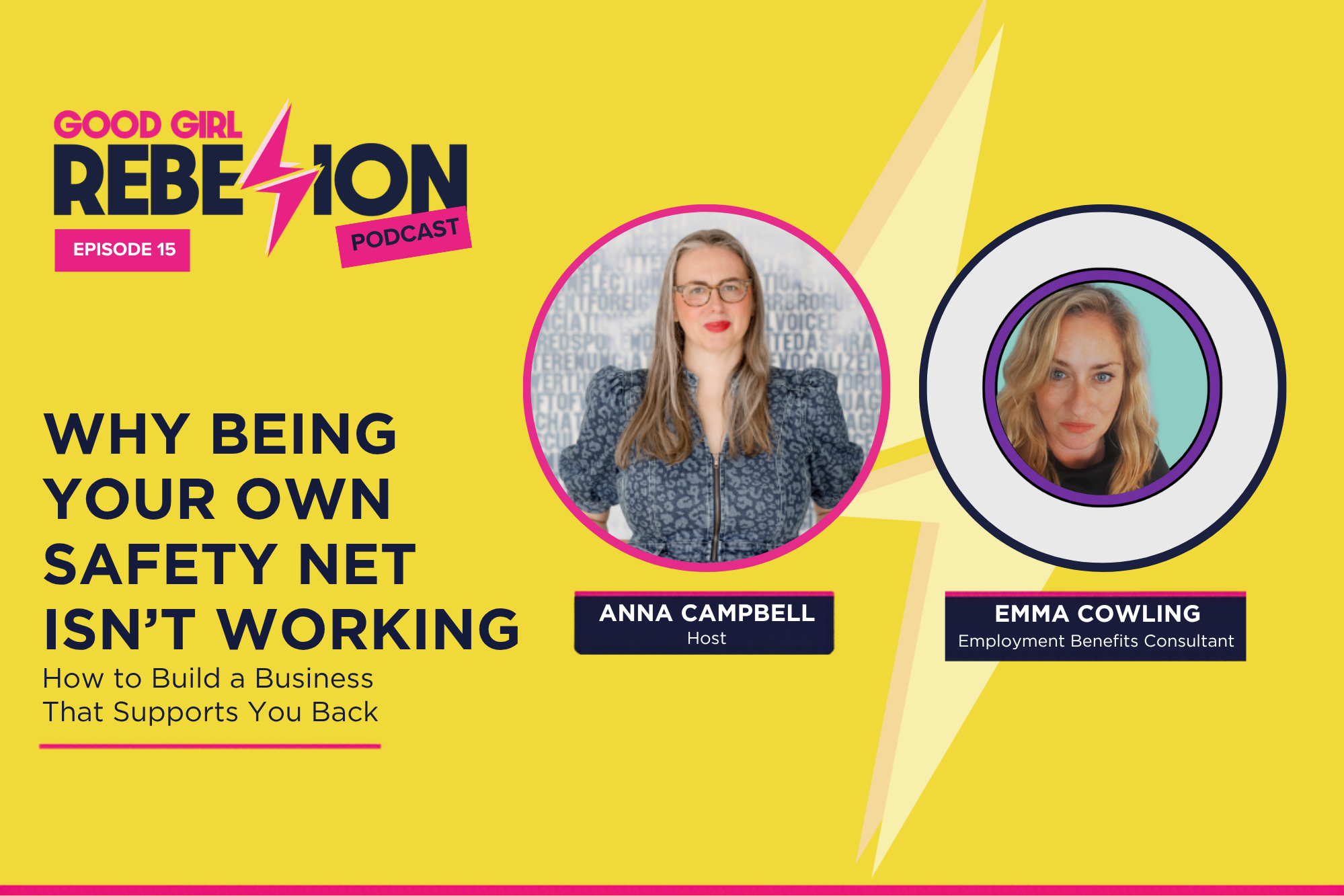
Episode 15 of the Good Girl Rebellion podcast.
Why Being Your Own Safety Net Isn’t Working: How to Build a Business That Supports You Back
When we talk about growing a business, we tend to talk about all the things we need to add. More skills. More clients. Better marketing. New qualifications. Coaching. Systems. Support. Perhaps eventually a team.
What we talk about much less is what happens if the person doing all of that suddenly can’t work.
That was the realisation behind this episode of the Good Girl Rebellion Podcast with Emma Cowling, founder of Refresh Rewards. Emma has more than 20 years’ experience working in employee benefits, including with global organisations such as Apple, and now helps values-led organisations create benefits that genuinely support their people.
When Emma and I first spoke, something clicked for me. Over the years I have invested tens of thousands of pounds in my professional and business growth. I have paid for qualifications, coaching, training and support because investing in getting better at what I do has always made sense to me.
But I had never really had a protection strategy.
For a long time, my protection strategy was essentially to keep my day job until I felt confident enough that the business could support me. Beyond that, I hadn’t given a great deal of thought to what would happen if I became ill, couldn’t work for a period of time or needed the sort of support that an employer might once have provided.
What do we leave behind when we become self-employed?
When we leave employment, we know we are leaving a salary. What can be less obvious is that we may also be leaving an entire infrastructure of support.
Exactly what that looks like depends on the organisation you worked for and the country you live in, but it might include things such as paid sick leave, pension contributions, medical insurance, life insurance, income protection, paid holiday, parental leave, professional development and access to various forms of employee support.
When those things are provided by somebody else, they can become almost invisible. You may not think very much about your pension contribution every month or what would happen if you were unable to work for a prolonged period because somebody within the organisation has already made decisions about those things.
Once you become self-employed, though, the responsibility for asking those questions moves to you.
Interestingly, Emma experienced this herself. Despite spending years working in employee benefits, when she first became self-employed she didn’t immediately think about recreating those protections for herself. They had always been something her employer provided.
That tells us something important. Sometimes the issue isn’t that we don’t understand the value of support. It is that we don’t notice the infrastructure around us until it disappears.
When the business safety net is you
There is another way that self-employed women may create a feeling of security, and this is where the conversation became particularly interesting to me.
Sometimes we make ourselves the safety net.
We keep the day job for longer. We keep costs very low. We do everything ourselves. We put off bringing in support. We keep the business small enough that it still feels controllable. We tell ourselves we’ll sort the pension, insurance, accountant, systems or other important pieces later, when the business is bigger.
And underneath all of that can be an assumption that we will continue to be able to cope.
The business does have a contingency plan. It is us.
There can be very sensible reasons for keeping costs down or doing a lot ourselves, particularly in the early stages of a business. This isn’t about suggesting that every decision to bootstrap a business is a psychological pattern.
But I do think there is an interesting connection here with one of the Invisible Rules I talk about, Keep Coping.
I should be able to manage this myself.
For capable women, self-reliance can feel like a virtue. We are used to figuring things out. We are used to being dependable. If something needs doing, we learn how to do it.
Those qualities can be enormously useful in entrepreneurship. But being capable is not the same as being a contingency plan.
At some point, it is worth asking whether the business has been built in a way that supports you, or whether its ability to function still depends almost entirely upon your continued health, availability and willingness to keep everything moving.
Responsible planning is not the same as eliminating uncertainty
One of the distinctions that came up in this conversation was the difference between planning responsibly and trying to eliminate uncertainty.
I think this matters because I am not interested in encouraging women to become more fearful about business.
Running a business involves uncertainty; there will always be things we cannot anticipate. There is no point at which we can create a perfectly risk-free version of self-employment and then finally give ourselves permission to move forward. But that doesn’t mean we have to ignore risk either.
Emma talked about asking practical questions. What would happen if you were unable to work for six months? Would you still be able to pay your bills? What would happen to the business? What if your partner became ill? What if you are the main earner in your household?
Your answers might lead you towards insurance, savings, professional advice, different business systems or simply the decision that your existing arrangements are adequate.
The important thing is that it becomes a conscious decision.
There is a difference between saying, I’ve looked at this and it isn’t something I need right now, and repeatedly thinking, I’ll deal with that when the business is bigger.
Why do we find it easier to invest in growth?
This was the question I kept coming back to.
I have found it incredibly easy to justify investing in growth.
Education, coaching and business training all feel very productive. They all point towards something we want to happen.
Protection is different because, by its nature, we may be spending money or time preparing for something we hope never happens.
It is easier to imagine the return on a qualification than the return on a contingency plan.
And when the business is still relatively small, anything that doesn’t appear to generate income can easily get categorised as an overhead that we can put off until later.
The difficulty is that when later arrives, the business is usually busier.
Emma and I talked about the difference between important work and urgent work. Most business days contain plenty of urgent things. There are emails to answer, clients to serve, invoices to send and deadlines to meet.
The work that protects the future of the business often doesn’t have a deadline.
It can therefore sit on next week’s to-do list, and then the following week’s, and then the following month’s.
Some of the most important things in a business are remarkably easy to postpone, right up until the moment they suddenly become urgent.
Is the self-employment pay gap also a protection gap?
This conversation also made me think differently about my work around the self-employment pay gap.
When we leave employment and build a business, it is natural to compare what we earn now with what we earned before.
If I earned a particular salary in employment, I might initially want my business to replace that income.
But those figures are not necessarily equivalent.
Your previous salary may have sat alongside employer pension contributions, paid holidays, sick leave, parental leave, training and other benefits. As a self-employed person, you may now be responsible for funding some of those things yourself.
So perhaps the question is not simply whether the business has replaced your salary. It is whether it has replaced your wider economic package.
Emma also talked about something she had encountered through conversations about sales and pricing: women using their previous corporate salary as a benchmark for what they should aim to earn from their business.
I find this fascinating because a benchmark can very easily become a ceiling.
If you earned £50,000 before, perhaps £50,000 becomes the figure that signifies success. You may never consciously decide that £50,000 is the maximum you are capable of earning. It simply becomes the reference point.
But why should the salary your previous employer chose to pay you determine the potential value of the business you build afterwards?
This is something I want to explore much further. I wonder whether alongside the self-employment pay gap there is another question we should be asking about a self-employment protection gap.
Freedom and money do not have to be an either/or
Many women move into self-employment because they want something different from their working lives.
Perhaps they want more flexibility. They want to decide when they work. They want to spend more time with their children or have more capacity for caring responsibilities. They want to accommodate their health. They want to choose the work they do or build something around their own energy and priorities.
Sometimes they simply want to do work they enjoy.
There is enormous value in all of those things.
But I wonder whether an Invisible Rule can creep into this conversation too.
If I get to do something I love, perhaps I shouldn’t expect to earn as much.
Or:
If I have flexibility, perhaps that is the trade-off for lower income.
Emma recognised something similar from the early days of her own business. There were times when she loved the work so much that she found herself doing it for free.
But enjoying the work does not make the value you create disappear.
There does not have to be an either/or in which we choose between meaningful, flexible work and being properly paid.
There may be a version of self-employment in which the business supports the life you want and provides financial security too.
Why I have mixed feelings about the “lifestyle business”
This also connects with a phrase I’ve never particularly liked: “lifestyle business”.
I understand what the phrase means. It generally describes a business built around the life its owner wants rather than one designed primarily for scaling fast, investment or an eventual sale.
There is nothing wrong with that idea. In fact, it sounds rather sensible.
But sometimes the phrase seems to carry an implied diminishment.
Oh, it’s a lifestyle business.
As if building a company around the life you actually want is somehow less serious than building a company that requires your life to revolve around it.
A business can generate significant revenue, employ people and make a substantial impact without being built for a multimillion-pound exit.
You can want growth without wanting infinite growth.
You can build something ambitious without wanting it to consume you.
And you can design a business around your life without apologising for the fact that your life matters.
The curse of the competent woman
Of course, protection isn’t only about pensions, insurance or savings.
Sometimes support means building a business in which you are no longer personally responsible for every task.
I often talk about what a friend of mine calls the curse of the competent woman.
Just because you can do something doesn’t mean you should.
This becomes particularly relevant in self-employment because we now have access to enough information and tools to teach ourselves almost anything.
You can learn how to do your bookkeeping.
You can make your own social media graphics.
You can figure out the website.
You can research every technical question.
You can spend hours teaching yourself the task rather than paying somebody who already knows how to do it.
The question we tend to ask is:
Can I do this myself?
But perhaps the better business question is:
Should I be doing this myself?
Emma gave the example of thinking about hiring a VA to take some marketing and administrative work off her plate. When she considered what it might cost across a year and compared that with the value of bringing in even one additional client, the calculation started to look completely different.
Support stopped being just a cost. It became a way of freeing the person responsible for growing the business to actually grow it.
I think this is particularly important for competent women because our capability can become the argument for why support isn’t necessary.
We know we can do it.
What we don’t always ask is what else we are not doing because our time and attention are being spent there.
Building your own self-employed benefits package
One of the things I found surprisingly exciting about my conversation with Emma was the idea of creating your own self-employed benefits package.
When we leave employment, it is easy to frame the conversation around everything we have lost but self-employment also gives us the opportunity to decide what support actually matters to us.
That might include traditional financial protections or pension provision, with appropriate professional advice. But Emma also talked about thinking more broadly about the benefits that support somebody’s life and wellbeing.
Perhaps it is healthcare.
Perhaps it is therapy or counselling.
Perhaps it is childcare.
Perhaps it is a gym membership.
Perhaps it is training.
Perhaps it is professional support.
Perhaps it is making additional pension contributions because yours took a hit during an earlier part of your life.
Perhaps it is paying somebody else to take responsibility for a part of the business that has been taking up far too much of your bandwidth.
Instead of asking how to recreate exactly what an employer once gave us, perhaps we can ask a more interesting question.
What do I want my business to provide for me?
What happens when the business owner becomes worth protecting?
Towards the end of our conversation, I asked Emma a question that I think gets to the heart of the episode.
What becomes possible when women stop relying on themselves as the safety net?
Because perhaps part of becoming a business owner is recognising that we are worth protecting too.
We spend so much time thinking about what the business needs from us.
We think about what clients need. We consider what our team needs. We think about what the next launch needs, what the customer needs, what needs fixing and what we need to do next.
But a sustainable business should not only be something we support.
It should eventually be capable of supporting us back.
That doesn’t mean eliminating risk. It doesn’t mean buying every possible financial product or creating an enormous support team. And it certainly doesn’t mean that everybody needs the same solution.
It means asking whether the choices you are making are deliberate.
What happens if you can’t work?
What are you relying on yourself to continue carrying?
Which protections did you leave behind when you became self-employed?
Which of them matter to you now?
What support could someone else provide better than you can?
Which important task keeps being pushed aside because it isn’t urgent?
And where has I can do this myself become I have to do this myself?
Those are useful questions whether you have been self-employed for six months or sixteen years.
You do not have to solve everything today
One thing I don’t want this episode to do is create an entirely new list of things women feel they are failing to do properly.
The answer is not to finish reading this article and immediately decide you need to sort your pension, insurance, will, accounts, business systems and every other piece of life administration before dinner.
Emma had a much more realistic suggestion: deliberately set aside some time for the important things.
Perhaps that is an hour once a month. Perhaps you choose one thing that has been sitting on the list and finally investigate it. Perhaps the action is simply speaking to somebody qualified who can tell you whether you need to do anything at all.
Breaking the work down matters because otherwise we can easily fall into another all-or-nothing pattern. Either we deal with everything perfectly, or the whole subject feels so enormous that we deal with nothing.
Sometimes thirty minutes is enough to move something from a vague worry at the back of your mind into an actual decision.
And there can be enormous relief in that.
Listen to How to Build a Business That Supports You Back
Listen to Episode 15 on the links below.


In this episode of the Good Girl Rebellion Podcast, I’m joined by Emma Cowling, founder of Refresh Rewards, to talk about what self-employed women may leave behind when they move out of employment, why so many of us invest far more readily in growth than protection, and how we can begin to build our own safety nets.
We talk about pensions, insurance and business protection, but this conversation is also much bigger than that. We explore the curse of the competent woman, outsourcing, why your previous salary can become an unconscious ceiling, the relationship between flexibility and income, and the difference between planning responsibly and trying to remove every possible uncertainty from the future.
Most importantly, we ask what it might mean to build a business that does not depend entirely upon your ability to keep coping.
Because your business needs your support.
But you are allowed to build one that supports you back too.
Listen to How to Build a Business That Supports You Back on the Good Girl Rebellion Podcast.
This episode is intended for general information and discussion and does not constitute financial, pension, tax or insurance advice. Please seek appropriately qualified professional advice for your individual circumstances.
It’s time.

About emma
Emma is the founder of Refresh Reward, an independent employee benefits consultancy. With over 20 years' experience, including working with global organisations such as Apple, she helps values-led organisations create benefits that genuinely support their people.
After starting her own business, Emma saw first-hand how many self-employed women were missing the support and protection they'd once taken for granted in the corporate world. That inspired her to create the Self-Employed Support Network, connecting women with trusted experts so they can build their own safety net and grow their businesses with confidence.
Website
https://refreshreward.consulting/
https://selfemployedsupportnetwork.com/
Socials