
Ep 12: Why Capable Women Burn Out
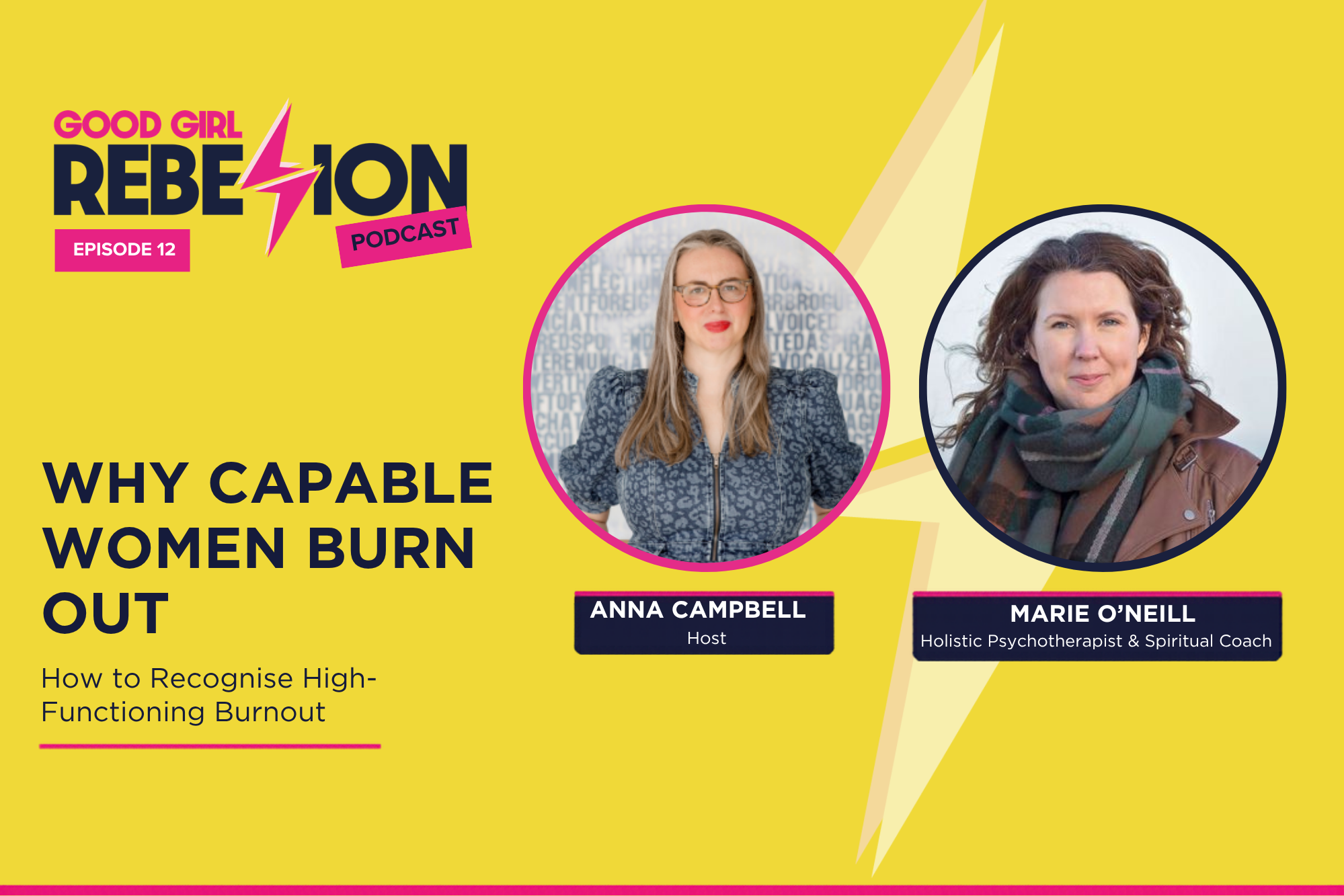
Episode 12 of the Good Girl Rebellion podcast.
Why Capable Women Burn Out: How to Recognise High-Functioning Burnout
From the outside, everything can look fine.
The work gets done, the deadlines are met, the family is cared for, the business keeps growing. People describe you as capable, reliable and someone who always seems to have it together.
But underneath, you feel permanently tired. Not the kind of tired that disappears after a good night's sleep, but the kind that settles into your bones. The kind that becomes so familiar you stop questioning whether it's normal.
In this episode of the Good Girl Rebellion podcast, Anna Campbell is joined by holistic psychotherapist and founder of Space for the Soul, Marie O'Neill, to explore high-functioning burnout and why so many women don't recognise it until their bodies force them to stop.
The conversation begins with Marie's own story. After years of unexplained symptoms, appointments, scans and specialist referrals, she eventually realised that what she had been experiencing wasn't simply bad luck or a mystery illness. It was the long-term impact of chronic stress and a nervous system that had been operating in survival mode for years.
The challenge, she explains, is that high-functioning burnout doesn't always look like burnout.
Many of us imagine burnout as the moment someone can no longer get out of bed, go to work or cope with daily life. But high-functioning burnout is different.
You keep going.
You meet your commitments.
You carry on looking after everyone else.
You smile.
You perform.
And because you are still functioning, both you and the people around you assume everything must be fine.
That idea feels particularly relevant for women.
Throughout the episode, Anna and Marie explore how good girl conditioning teaches many women to become exceptionally good at overriding themselves. From an early age, we're rewarded for being reliable, thoughtful and helpful. We become the people others can depend on, often without stopping to ask what it is costing us.
Marie introduces the idea of internal gaslighting - the way we dismiss our own needs while demanding more and more from ourselves.
"I should be able to cope."
"It's only a busy week."
"I'll rest once this project is finished."
The problem is that there is always another project.
Another deadline.
Another person who needs us.
Eventually, our bodies begin communicating in ways that are harder to ignore.
One of the most powerful parts of the conversation explores the difference between stress and chronic stress.
Marie explains that she didn't think she was stressed because stress had become her normal. Her nervous system was constantly vigilant, constantly prepared for the next demand, and because she'd lived that way for so long she no longer recognised it as unusual.
It raises an important question.
How many women are living in a state of permanent alertness without even realising it?
The conversation then moves into one of Marie's specialist areas: high sensitivity.
Around 15–20% of people naturally have a more sensitive nervous system. They process more information, notice more of what's happening around them and often experience the world more deeply. Yet society often treats sensitivity as something to overcome rather than understand.
Marie offers a completely different perspective. Sensitivity isn't a weakness, it's just a different way of experiencing the world.
The challenge is that many workplaces and cultures reward constant productivity, speed and endurance, leaving sensitive people feeling as though they're somehow getting life wrong. Rather than asking people to become less sensitive, Marie encourages us to become more understanding of our own nervous systems and to design lives that support how we naturally function.
That theme of self-understanding continues throughout the episode.
Anna reflects on learning to reconnect with her own body after years of overriding its signals. Together they discuss how many women have become so disconnected from themselves that they no longer recognise hunger, exhaustion, overwhelm or even intuition until those feelings become impossible to ignore.
Our bodies, Marie suggests, are constantly communicating with us - the question is whether we've learned to listen.
One of the most refreshing parts of the conversation is the shift away from fixing ourselves. So much personal development begins with the assumption that something is wrong with us.
We need to become more productive.
More resilient.
More disciplined.
Marie challenges that narrative. Instead of asking, "How do I fix myself?" perhaps we need to ask, "How do I create a life that supports who I really am?"
That shift changes everything. The discussion naturally turns towards joy, not as something we earn after finishing the to-do list, but as something that deserves a place within our lives now. Many women treat rest as a reward, something to be enjoyed once everything else has been completed. But if the list never truly ends, neither does the permission to rest.
As Anna reflects during the conversation, perhaps we don't need recovery at the end of the project, perhaps we need it throughout.
The episode also explores the impact this work can have on our relationships.
When we've spent years being the dependable one, setting boundaries can feel unsettling. Partners, family members and colleagues often become accustomed to a particular version of us. Changing that dynamic can feel uncomfortable, not because the boundaries are wrong, but because the relationship itself has to adapt.
Marie explains that this is why nervous system work matters so much.
Logically, we may know we need to say no. Emotionally, our bodies may still interpret disappointing someone as a threat.
Understanding that response allows us to approach change with far more compassion.
Towards the end of the conversation, Anna asks what women can do if this episode feels painfully familiar.
Marie's answer isn't another productivity system or wellbeing checklist.
It's much simpler.
Stop criticising yourself.
The patterns that have brought you here developed for a reason. They were often intelligent survival strategies that helped you belong, succeed and stay safe.
Lasting change rarely comes from self-judgement - it comes from self-understanding.
The episode finishes with a great reminder that perhaps the greatest gift we can give ourselves isn't perfect health, constant happiness or a life without challenges - it's becoming the person who has our own back. Building a relationship with ourselves that's based on compassion rather than criticism because when we stop overriding ourselves and start listening instead, we don't become weaker. We become more whole.
key moments in this episode
What high-functioning burnout is and why it's often so difficult to recognise
Why chronic stress can become your normal state
The connection between good girl conditioning and burnout
Understanding internal gaslighting and the pressure to keep coping
Why sensitivity is a strength rather than a weakness
Learning to listen to your body's signals before they become impossible to ignore
The difference between fixing yourself and understanding yourself
Why rest shouldn't have to be earned
How boundaries can change relationships
Why self-compassion creates more lasting change than self-criticism
What becomes possible when women stop overriding themselves and start listening to themselves
Listen to Episode 12 on the links below.



If you've ever looked like you're coping while privately feeling exhausted, this conversation will remind you that there is another way. Not by becoming someone different, but by learning to understand and support the person you've been all along.
It’s time.

About marie
Marie O'Neill is a holistic psychotherapist, a spiritual coach and founder of Space for the Soul, where she helps highly sensitive people heal from chronic stress, burnout and trauma by working with the body, the nervous system, mind and soul. Her work combines psychotherapy, mindful self-compassion and nervous system regulation, helping people understand that their sensitivity isn't something to overcome, but something to understand.
I first heard Marie speak at a networking event and I really wanted to get her on the podcast because I felt so many of us could relate to her experience, particularly of high-functioning burnout and the way that she reframes it, what we often think of as a weakness, but looking at it more as a source of wisdom.
If you'd like to learn more about understanding your highly sensitive nervous system and working with it rather than against it, Marie has created a free 30-minute Sensitivity Masterclass. You can access it here:
https://www.spaceforthesoul.co.uk/sensitivity-masterclass